Granite Mining Process: From Quarry to Finished Stone
Granite is one of the common natural stones used in building, home interiors, monuments, countertops and architectural projects. However the shiny granite surface that you see in a project begins much earlier deep inside a natural granite deposit.
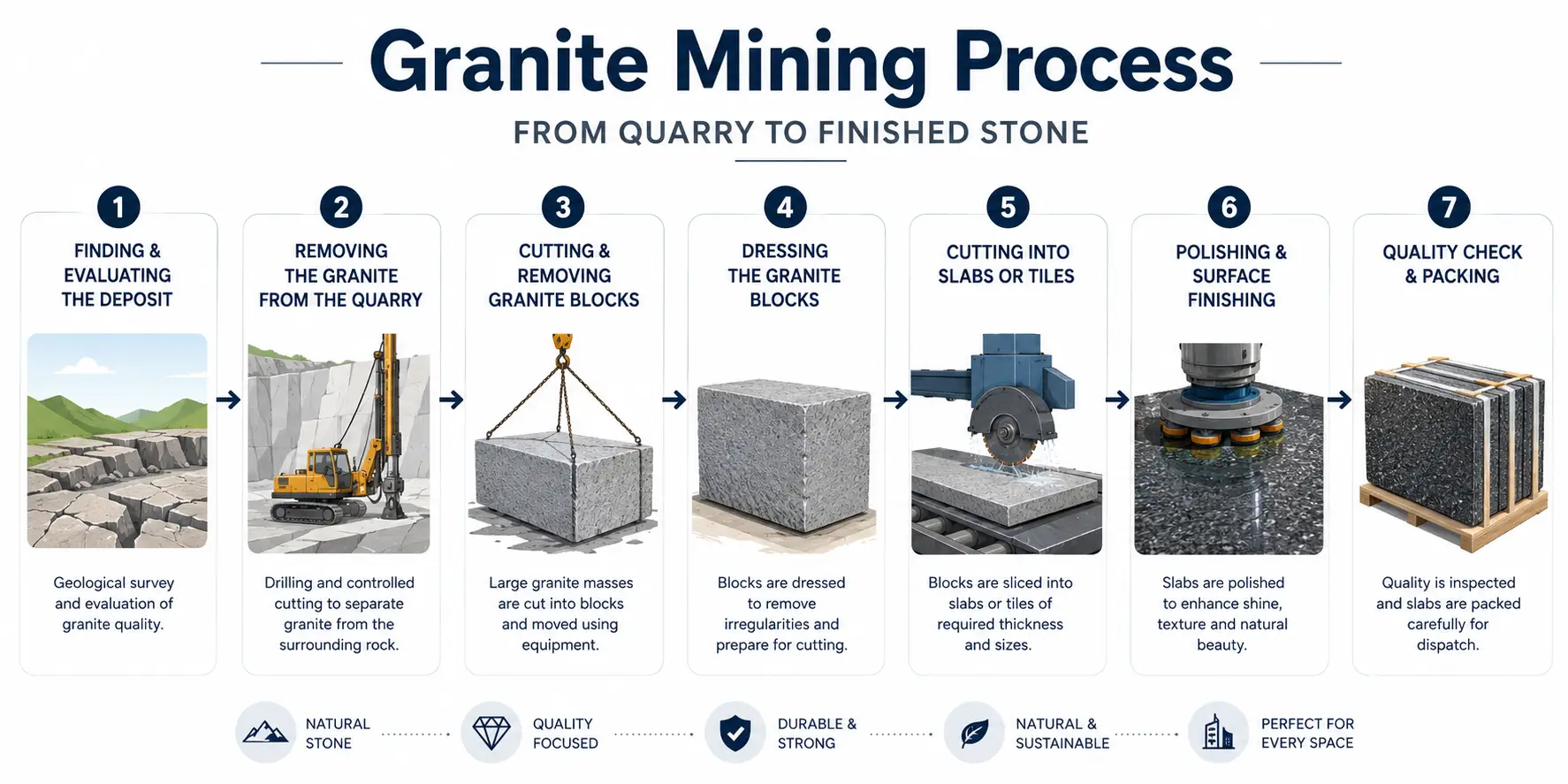
The journey from a granite quarry to a finished stone involves extraction, block selection, cutting, surface finishing, sizing and quality inspection.
Understanding this process helps buyers, architects, builders and homeowners see why granite quality, appearance and price can vary.
What Is Granite Mining?
Granite mining is the process of extracting blocks of natural granite from a quarry.
Unlike mining where material may be crushed into small pieces, dimension-stone granite is extracted in large blocks so that the natural colour, pattern and structure of granite can be preserved.
The quality of the granite deposit is important because fractures, joints, cracks and other natural defects can affect whether a granite block is suitable for processing. The Indian Bureau of Mines notes that characteristics such as colour, texture, grain size, density, hardness, water absorption and freedom from defects are important when evaluating granite.
Step 1: Finding and Evaluating the Granite Deposit
The process starts with finding an area that has granite and looking closely at the rock formation.
Before taking the granite out the quarry has to check:
Colour and natural pattern
Grain structure
Rock quality
Fractures and joints
How big the blocks can be
Hardness and density
How much of the granite can be used
This check helps decide if the granite in the area can make blocks.
Step 2: Removing the Granite From the Quarry
Once a good area of granite is found workers carefully take the granite away from the rocks, around it.
Step 2: Removing the Granite From the Quarry
Once the right place with granite is found the workers take the granite carefully from the rock, around it.
Modern quarrying can use techniques such as diamond wire sawing and controlled drilling to create cuts. Depending on the granite quarry and geological conditions other controlled extraction methods may also be used.
The objective is simple: remove granite blocks while minimising unnecessary cracks and damage.
Natural Stone Institute describes granite quarrying as a process involving extraction, cutting, staging and transportation of granite.
Step 3: Cutting and Removing Granite Blocks
After separation the large granite mass is divided into blocks.
The granite blocks are then moved using quarry equipment and prepared for transportation.
Block selection is important because not every extracted granite piece will have the commercial value. A granite block with colour consistent structure and fewer defects can be more suitable for premium applications.
Step 4: Dressing the Granite Blocks
Before factory processing rough granite blocks may be dressed to remove irregularities and prepare them for accurate cutting.
The Indian Bureau of Mines identifies dressing, cutting/sawing, surface grinding and polishing and edge cutting/trimming, as granite-processing operations.
Step 5: Cutting Granite Into Slabs or Tiles
The selected granite block is transported to a processing facility where it is sawn into slabs or other required sizes.
Modern diamond cutting equipment allows granite to be cut accurately into thicknesses and formats.
This stage transforms a granite quarry